Features Collaboration
Three people, one case
- One shared case.
- Roles that hold.
- Company profiles reused.
- Only the attorney files.
The applicant, the employer and the attorney, in one shared case.

Try it.
Three people around one case. Hover each of them to light up their part.
Hover or focus a person to see their part of the case.
- Answer the questions
- Upload documents
- Company sections
- Review
- Approve and lock
- File with USCIS
Roles are enforced in the database, so no screen can blur them.
Applicant, employer and attorney share one case.
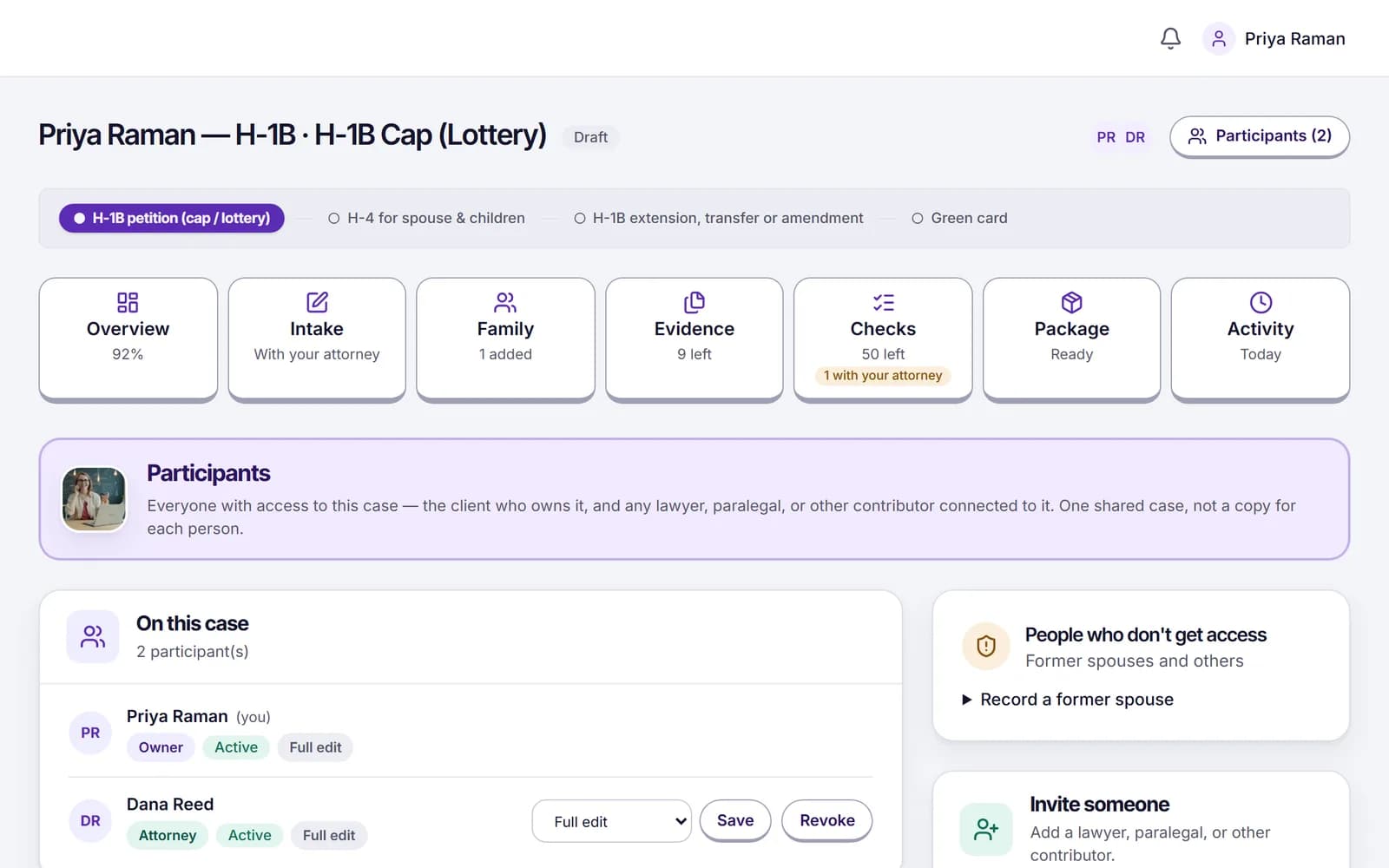
The client, anyone helping them (an employer or HR, or a family member), and the attorney or paralegal work in the same case. Each person sees their own part.
People join by invitation, and roles decide who can see, change, approve or file. Roles are enforced in the database as well as on the screens.
Employers keep a company profile that is reused across cases, so the company details aren't typed again for every employee.
Three steps.
- Open the caseThe client or the attorney starts it and picks the path.
- Invite the othersThe applicant, the employer and the attorney get their invitations.
- Each does their partThe client prepares; the attorney reviews, decides and files.
Key points
Prepared by you. Guided and approved by your attorney.
Start your case and invite your attorney, or sign in to your firm's cases.