A smarter way to manage the immigration journey.
Create cases across employment, family and investment, invite clients to a structured intake, and review organized case information, while you keep control of the legal decisions and the representation.


Every client. What needs you.
My cases shows each client's case, how ready it is and what it's waiting on. Open one, and must-fix items sit apart from the calls that are yours to make.
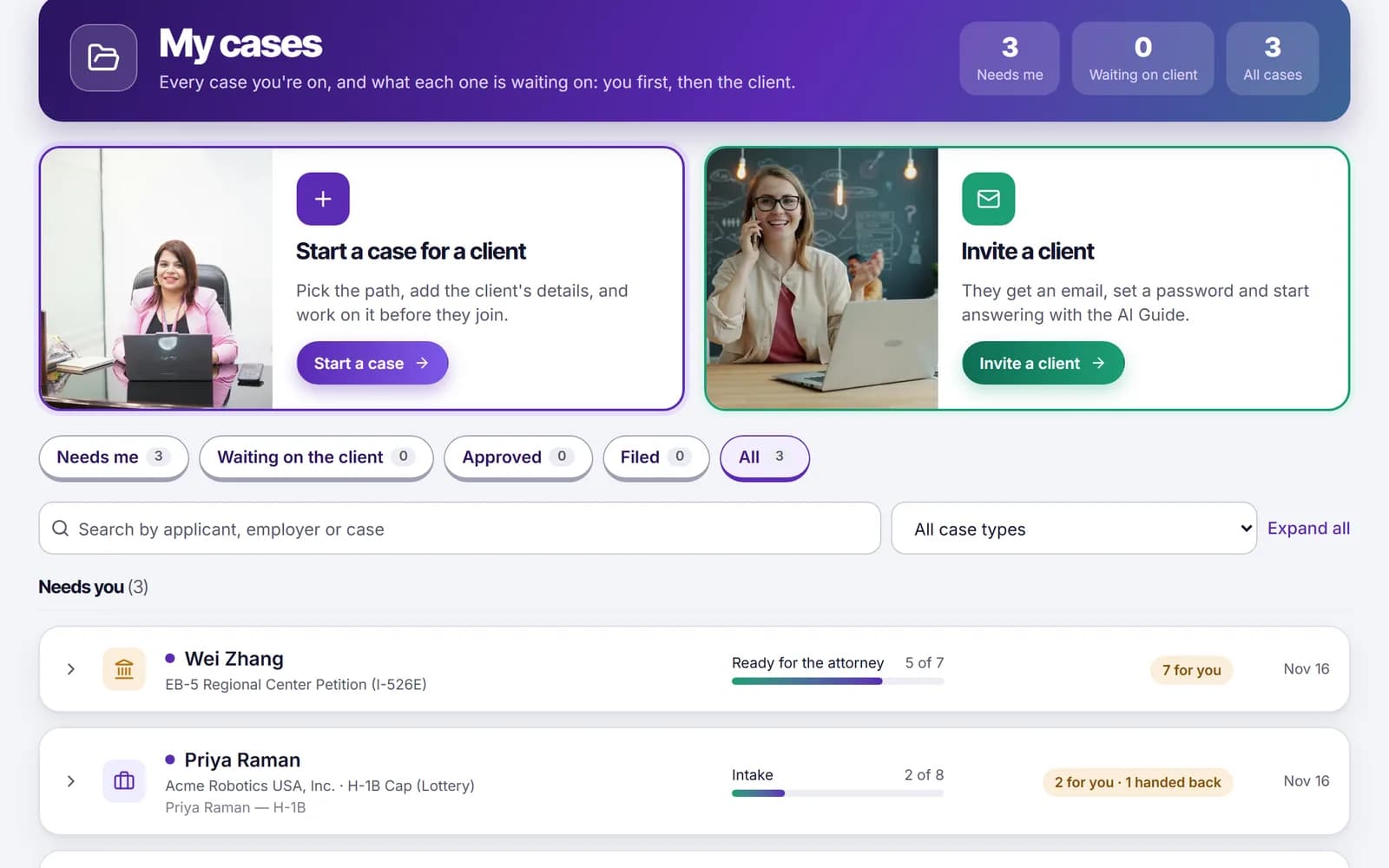
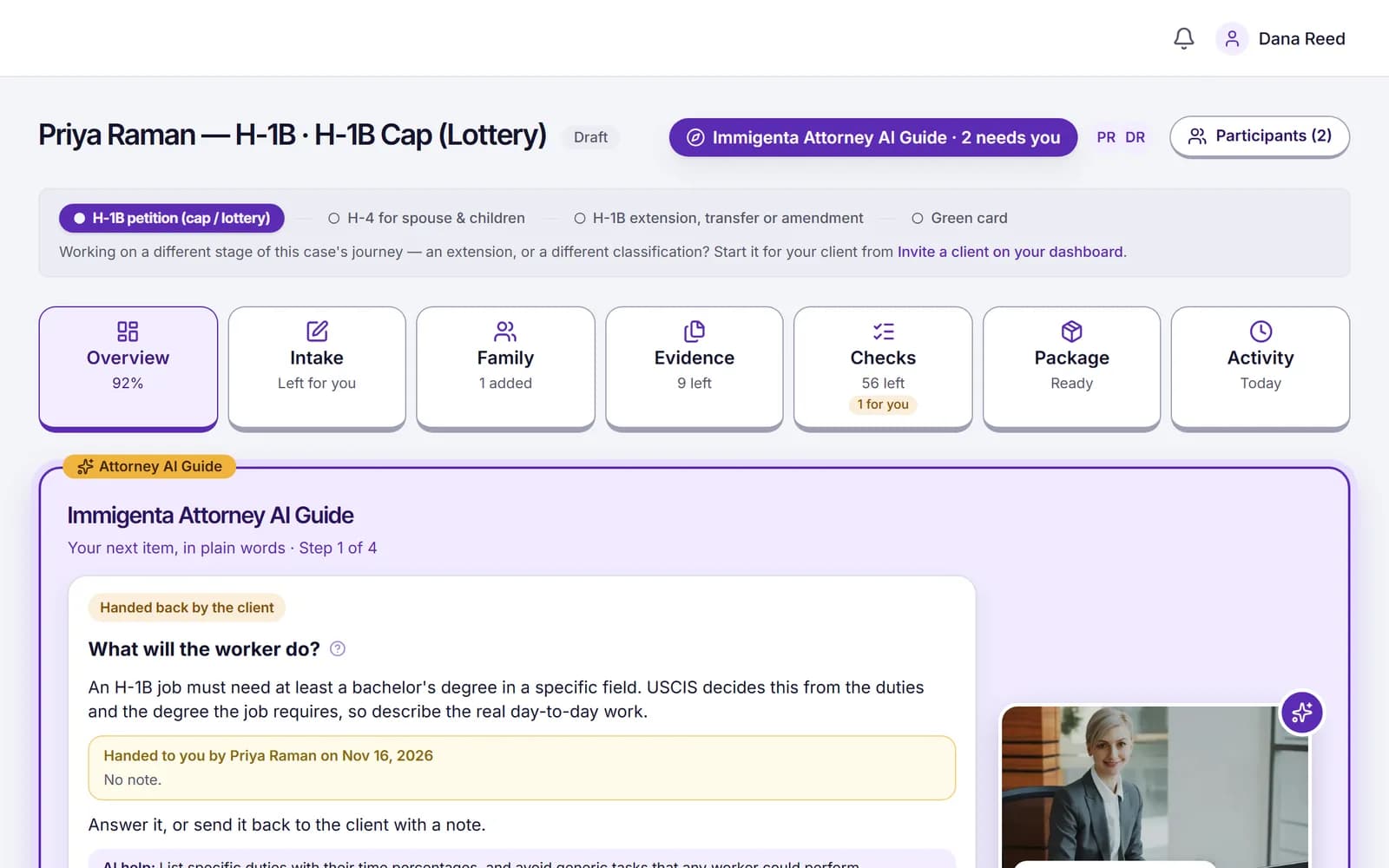
Organized, checked cases. Your legal judgment.
Your clients prepare. Immigenta organizes and checks. You guide, decide, approve and file.
Cases across every category
Employment, family and investment, in My cases.
Cases across every category
Start employment, family and investment cases from My cases, at any stage, and see what each one needs from you.
Learn moreInvite clients to a structured intake
Send a link; they answer in plain words.
Invite clients to a structured intake
Send your client a link. They set up an account and answer the case's questions one at a time, in plain words.
Learn moreYour own AI Guide
It suggests. You decide.
Your own AI Guide
The Attorney AI Guide walks you through your part: what the client handed back, the checks waiting for you, your questions, the letter and approval. It suggests; you decide.
Learn moreVerifications and checks
Answers checked against the documents.
Verifications and checks
Answers are checked against the documents and against each other, with each finding tied to the item it comes from.
Learn moreMust fix, or yours to review
Gaps go to the client; judgment comes to you.
Must fix, or yours to review
Clear gaps go back to the client to fix. Judgment calls come to you, so you spend your time on the decisions.
Learn moreApprove, lock and file
Then download the filing package.
Approve, lock and file
Approve and lock the case, then download the filing package: the filled USCIS forms and the evidence, in order.
Learn more
The client prepares. You decide.
 Client preparesAnswers and documents
 CheckedGaps back to the client
 You decideThe legal calls are yours
 Approve, lock, fileThe package, in order
A checked case, ready to sign.
You approve and lock the package. Only you or your paralegal file it. Clients never submit, pay or mail anything to USCIS.


- Eligibility & Evidence ReportEach requirement, the evidence behind it and its exhibit: in place, needs review or missing.
- The filled USCIS formsEditable PDFs of the real forms, with continuation pages instead of cut-off text.
- The letter draftA petition or cover letter drafted from the case facts, with exhibits cited. You mark it reviewed.
- The filing packageForms and one evidence PDF with exhibit tabs, in a ZIP, with a Before mailing checklist.
Where the firm's work moves.
When the client prepares a large part of the case correctly, your team spends less time on data entry, chasing and fixing, and more time reviewing a checked case and making the calls only an attorney can.
Before
The firm prepares. The client fills a questionnaire.
Client
Firm
With Immigenta
The client prepares. The firm decides.
Client
Firm
The attorney decides. Always.
The software prepares the case. Legal judgment, approval and filing stay with the attorney, and the system enforces it.
The attorney approves and files
Only the attorney or paralegal approves, locks and files. Clients never submit, pay or mail anything to USCIS.
It never decides eligibility
Checks flag what's missing or inconsistent. Whether someone qualifies is always the attorney's call.
Roles enforced in the database
Who can see, change, approve or file is enforced in the data itself, beyond what the screens allow.
AI help is labelled as help
Every AI answer is marked "AI help". It explains, and a person applies every suggested value.
Four ways in. One shared case.
Send your client a link, join a case your client started, or be invited by a company's HR. Every case lands in your My cases.
- Your attorney starts it
Your attorney sends you a link.
Your attorney starts it- Your attorney picks the case type and invites you by email.
- You open the link, set up your account, and your case is ready.
- You answer your questions, guided one at a time.
- You start it
Start your case. Invite your attorney.
You start it- Pick your path and the stage you're at.
- Name your attorney at sign-up, or invite them from your case.
- They join your case and review what you prepare.
- No attorney yet
Connect with an independent law firm.
No attorney yet- Start your case on your own.
- If you don't have an attorney, the guide shows the independent law firm that works with Immigenta.
- Connecting it is your choice. Once connected, the firm can see your case and work on it with you.
- Your company starts it
HR starts the case for an employee.
Your company starts it- Someone at the company starts the case and says who it's for.
- They invite the employee and the company's attorney.
- The employee answers their part; HR answers the company's.
Immigenta is not a law firm and doesn't give legal advice. Your attorney, or the independent law firm you choose to connect, gives the legal advice, approves and files. How one shared case works

Your clients prepare. You decide.
Sign in to your firm's cases, or set up your firm and invite your first client.